


Why Millions Celebrate Ganapati Festival in Mumbai?

Updated: Jun 11
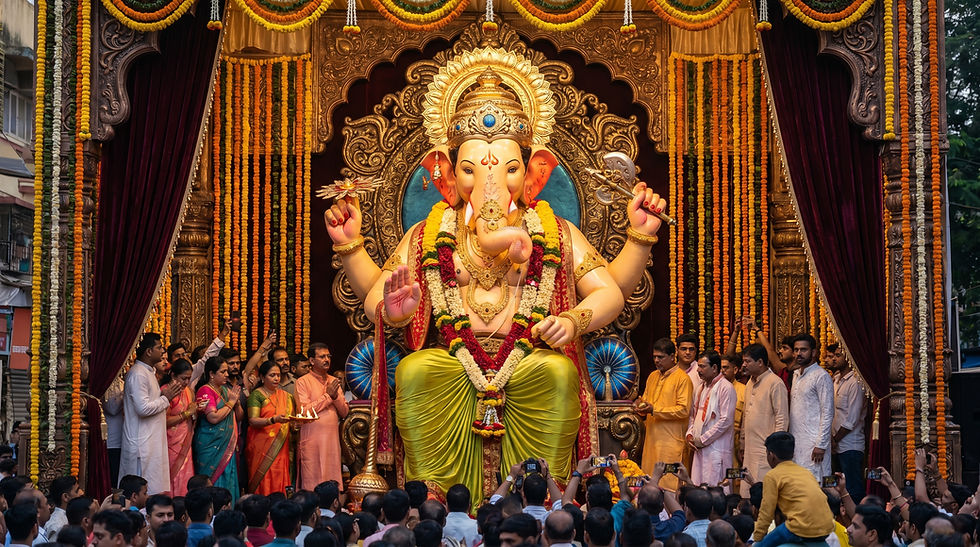
Every August or September, Mumbai transforms. The city that never sleeps — India's financial capital — trades its corporate rhythm for ten days of collective devotion. Streets fill with towering idols, drumbeats shake building walls, and over 20 million people move with a single purpose. This is Ganesh Chaturthi, locally called Ganapati Festival — one of the world's most extraordinary public celebrations.
For international travelers, Mumbai's Ganapati Festival offers something rare: unfiltered access to living culture, where history, politics, spirituality, and street energy collide simultaneously. This guide gives you everything you need to understand, experience, and navigate it responsibly.
Who Is Lord Ganesha?
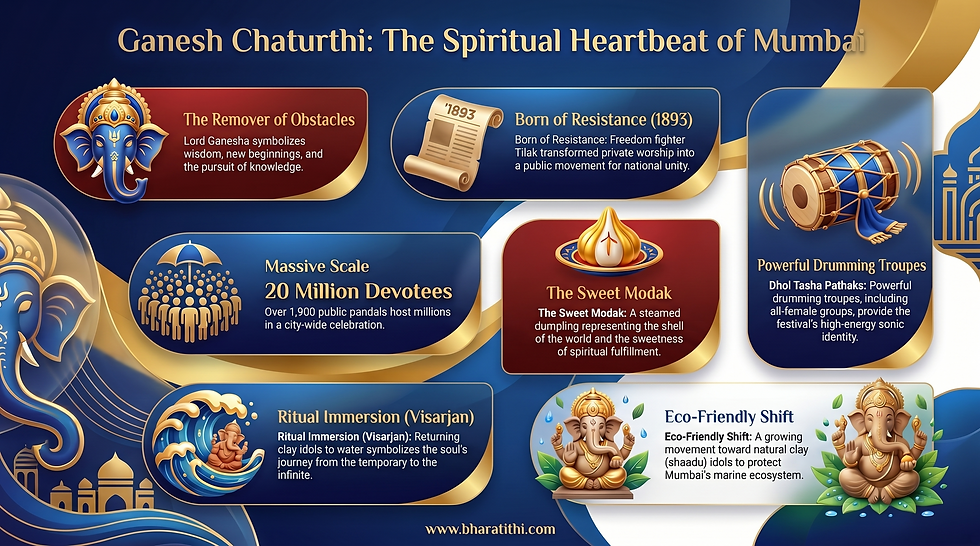
Lord Ganesha is one of Hinduism's most recognized and beloved deities. He has the body of a human and the head of an elephant — a form described across ancient Hindu scriptures. Hindus worship Ganesha as the Remover of Obstacles and the God of Wisdom, Beginnings, and Good Fortune.
Before starting any important venture — a business, a journey, a wedding, an exam — Hindus traditionally seek Ganesha's blessings first. His elephant head symbolizes intelligence and memory. His large ears represent listening carefully. His small eyes suggest focused attention. His broken tusk, which he holds, symbolizes sacrifice made in the pursuit of knowledge.
Ganesha's vehicle (mount) is a small mouse called Mushak, symbolizing that even the smallest creature can carry the divine. He is known by over 108 names, including Ganapati (Lord of Devotees) and Vinayaka (Supreme Leader).
Origin and History of Ganesh Chaturthi
Ganesha worship has ancient roots in Hindu tradition, referenced across the Puranas (ancient Hindu texts). For centuries, families celebrated Ganesh Chaturthi — meaning the "fourth day" of the lunar month of Bhadrapada (August–September) — privately inside their homes.
Bal Gangadhar Tilak: The Man Who Changed Everything
The festival's modern public scale was born of political necessity, not just piety. In 1893, Indian freedom fighter Bal Gangadhar Tilak made a historic decision. The British colonial government had banned public political gatherings to suppress India's independence movement. Tilak's response was brilliant: he published a call to action through his Kesari newspaper and transformed the private household ritual into a massive public community celebration called a mandal (community gathering).
By framing political organizing as religious celebration, Tilak created a space the British could not easily ban. What began in Pune quickly spread to Mumbai. The festival became a tool for social unity across caste and class lines — exactly what Tilak intended. Today, that legacy lives in every public pandal (temporary decorated shrine) across Maharashtra.
Why Mumbai Is the Heart of Ganapati Festival
Mumbai currently hosts over 1,900 public pandals, making it the undisputed center of public Ganapati celebrations globally. The scale defies ordinary logic:
Lalbaugcha Raja pandal alone draws over 1.5 million visitors daily.
Over 20,000 police officers manage crowd control during the festival.
74 road closures are implemented across the city.
2.5 million people gather at Girgaon Chowpatty on Visarjan night.
The festival is Mumbai's annual energy source — the one moment when the city's individualistic hustle converts into a collective rhythm.
Famous Ganapati Mandals in Mumbai

Realistic expectation: Major mandals involve significant waiting. Plan visits during early morning hours (before 7 AM) for shorter queues. Mid-week days in the first half of the festival are significantly less crowded than weekends and the final two days.
The 10-Day Festival: What Actually Happens
The festival begins with Ganesh Sthapana — the ritual installation of Ganesha's idol inside the home or pandal. A priest performs Pranpratishtha (the ritual of inviting the divine into the idol). From this moment, the idol is treated as a living presence.
Daily rituals include:
Morning Aarti (prayer ceremony with light) — typically at 7 AM
Evening Aarti — at sunset
Bhajans (devotional songs) and cultural programs throughout the day
Modak (sweet offering) distributed as prasad (blessed food)
The festival builds in intensity across ten days, culminating in the grand Visarjan (immersion) on the tenth day — Anant Chaturdashi.
Aarti: The Spiritual Heartbeat

Aarti is a Hindu prayer ritual where a lit lamp is waved in circular motions before the deity while devotees sing devotional songs. The most famous Ganesh Aarti is "Sukhkarta Dukhaharta" — a Marathi-language prayer celebrating Ganesha as the giver of happiness and remover of suffering.
During Aarti, the atmosphere shifts completely. Thousands of voices rise together, drums beat in rhythm, and the air fills with incense smoke. For visitors, attending Aarti — even without understanding the language — is a profoundly affecting experience.
Visitor etiquette during Aarti: Stand respectfully, avoid walking through the prayer area, silence your phone, and do not photograph with flash.
Modak: Lord Ganesha's Sacred Sweet

Modak is a small steamed dumpling made from rice flour, filled with coconut and jaggery (unrefined cane sugar). Ganesha is specifically called "Modakpriya" — meaning "one who loves modak." The symbolism is layered: the outer rice-flour shell represents the physical world, while the sweet interior represents spiritual fulfillment.
The traditional version, Ukadiche Modak (steamed modak), is considered the most sacred offering. During the festival, sweet shops across Mumbai sell thousands daily. Trying one is a non-negotiable cultural experience for any visitor.
Dhol Tasha Pathaks: The Sound of the Festival

The sonic identity of Ganapati Festival is the Nashik Dhol — a large double-sided drum — paired with the Tasha, a smaller high-pitched drum. Groups of performers called Pathaks train for months before the festival.
What makes this tradition remarkable today is the rise of Female Dhol Pathaks. Traditionally a male domain, women now actively participate in groups like the Girgaon Dhvaja Pathak, carrying 11–12 kilogram drums for hours through processions. They describe the endurance as a "divine power."
As Pathaks move through Mumbai's neighborhoods — including areas with Christian and Muslim residents — these communities often greet the processions with garlands and celebration. This cross-community participation reflects the social unity Tilak originally envisioned in 1893.
Lezim is a traditional folk exercise performed with small jingle-instrument props — a rhythmic warm-up and performance tradition associated with Maharashtra's cultural heritage, often seen during processions.
Visarjan: The Grand Finale
Visarjan means immersion. On the tenth day, Ganesha idols are carried through the streets in massive processions — accompanied by Dhol Tasha Pathaks, dancing crowds, and the chant "Ganapati Bappa Morya!" (meaning "Lord Ganapati, please come again!") — before being immersed in water.
The spiritual meaning is profound: the clay idol represents the mortal form. Returning it to water symbolizes the dissolution of the temporary into the infinite.
Lalbaugcha Raja undertakes a 22-hour final journey before immersion on a hydraulic raft into the Arabian Sea. The immersion at Girgaon Chowpatty draws approximately 2.5 million people.
The moment the idol enters the water, Dhol music stops. Thousands stand in silence. Witnesses consistently describe this as the most emotionally powerful moment of the entire festival.
Primary immersion locations in Mumbai:
Girgaon Chowpatty (most famous)
Juhu Beach
Dadar Chowpatty
Eco-Friendly Ganapati Movement
Environmental concerns around Plaster of Paris idols and chemical paint entering water bodies have driven a significant shift. Mumbai now sees growing adoption of natural clay idols (called shaadu), which dissolve cleanly in water. Towns like Pen in the Raigad district are famous for producing high-quality eco-friendly idols crafted months in advance. Municipal authorities also set up artificial immersion ponds across neighborhoods for smaller idols, reducing direct river and sea pollution.
Foreigner's Survival Guide

FAQ Section
Q1: Is Ganapati Festival safe for foreign visitors?
Generally yes. Mumbai's Ganapati is a family-oriented public celebration. Standard crowd-safety precautions apply — be aware of pickpockets in dense crowds and stay near exits.
Q2: What does "Ganapati Bappa Morya" mean?
It means "Lord Ganapati, please come again." Morya refers to a 14th-century saint devotee of Ganesha. It is the festival's defining chant.
Q3: Can tourists join the procession?
Yes. Processions are public. Respectful participation is welcome.
Q4: Can women participate in Dhol Tasha groups?
Absolutely. Female participation in Dhol Pathaks is now well-established and celebrated.
Q5: What should visitors wear?
Modest clothing. Avoid sleeveless tops near religious spaces. Comfortable walking shoes are essential.
Q6: Is photography allowed inside pandals?
Policies vary by mandal. Always ask organizers before photographing. Never use flash during Aarti.
Q7: When exactly is Ganesh Chaturthi celebrated?
On the fourth day of the Hindu lunar month of Bhadrapada, which falls in August or September on the Gregorian calendar. The exact date changes yearly.
Q8: What is prasad?
Prasad is food that has been offered to the deity and is then distributed to visitors as a divine blessing. Modak is the most common prasad during Ganapati.
Q9: Is the festival only celebrated in Mumbai?
No. Pune, Nashik, Nagpur, and Kolhapur all have significant celebrations. Mumbai is the largest.
Conclusion
Mumbai's Ganapati Festival is far more than a religious event. It is a living document of Indian history — born from political resistance in 1893, shaped by Maharashtra's cultural traditions, and powered by the collective energy of millions. For international visitors, it offers access to something rare: a city's genuine soul.
Understanding the festival means understanding Mumbai — its resilience, its complexity, and its extraordinary capacity to hold ancient tradition and modern urban life in the same ten days. Whether you stand in silence at Visarjan, taste your first Modak, or hear the Nashik Dhol shake the street beneath your feet, Ganapati Festival will remain one of the most memorable experiences of your life.
"Ganapati Bappa Morya!"


Comments