


From Bombay to Mumbai: The Fascinating Story of Shree Mumbadevi Temple

Updated: Jul 31

Picture this. You have just landed in Mumbai — India’s largest city, home to over 20 million people, and one of the most overwhelming urban experiences on the planet. The air hits you first: warm, spiced, alive with diesel and jasmine. Then the noise. Then the colour. Most first-time visitors head straight for the waterfront promenade, the colonial-era train station, or the famous street food markets. All of those are worth seeing. But if you want to understand what this city actually is — where it came from, why it exists, and who it belongs to — you need to find a small, unassuming temple tucked inside one of the city’s most chaotic bazaars.
The temple is called Mumbadevi. And without it, the city you are standing in would not even have its name.
First Things First: Why Is It Called “Mumbai”?
If you have ever wondered why the city was called Bombay for so long and is now called Mumbai, the answer lives in this temple. “Bombay” was a name the Portuguese gave the islands in the 16th century — likely a mispronunciation of the Portuguese phrase Bom Bahia, meaning “good bay.” The British kept it. But the people who actually lived here, the original fishing communities called the Koli people, never called it Bombay at all. They called it after their goddess.
The name “Mumbai” breaks down like this: “Mumba” comes from the ancient Sanskrit words Maha-Amba, meaning “the Great Mother.” And ”ai” (pronounced “aai”) simply means “mother” in Marathi, the local language of this region. So “Mumbai” quite literally translates as Mother Mumba — a double expression of reverence for the goddess. When India officially renamed the city from Bombay to Mumbai in 1995, it was not a political stunt. It was a six-century-old name finally getting its due.
A 350-Year History in a City That Never Stops Moving
The original Mumbadevi Temple was built around 1675 near Bori Bunder — a bustling creek and landing dock that no longer exists, now buried beneath one of the world’s most famous railway stations. If you have passed through Chhatrapati Shivaji Maharaj Terminus (the spectacular Gothic-Victorian train station that appears in countless photographs of Mumbai), you have stood near the spot where this temple first stood. A devout Hindu woman, herself named Mumba, is believed to have built the first shrine there.
The original temple did not survive. Sometime between 1739 and 1770 — during the period when the British East India Company was aggressively reshaping the islands into a colonial port city — the temple was destroyed. The exact reason is lost to history. What followed was a new temple, built at its current location in the Bhuleshwar neighbourhood, completed in 1737. That is the temple you can visit today: nearly 300 years old, still standing, still full of worshippers every morning.
What You Will See Inside: A Goddess With No Mouth
Walking into Shree Mumbadevi Temple for the first time is a sensory experience that is hard to prepare for. The narrow lane leading up to it is a riot of colour and commerce: vendors selling garlands of orange marigolds and white jasmine (traditional offerings for the goddess), small shops stacked with brass idols and incense sticks, the sweet smell of prasad — a blessed food offering, similar in concept to communion bread, that devotees receive after prayer. And then, through a doorway, everything changes.
The interior is surprisingly intimate. At its centre sits the idol of Mumbadevi: a figure carved from black stone, her face painted a deep orange-red, adorned with an elaborate silver crown, a diamond nose ring, and layered gold jewellery. She is placed on an altar decorated daily with fresh marigold flowers. Before her stands a metal tiger — her vahana, or divine vehicle. In Hindu iconography, a tiger is associated with Durga, one of the most powerful forms of the Divine Mother, representing fearlessness and the defeat of evil.
The temple complex is more than just a single idol. Other shrines inside are dedicated to Ganesh (the beloved elephant-headed god of new beginnings, whom you will encounter everywhere in India), Hanuman (the monkey god, a symbol of devotion and strength), Mahadev (another name for the god Shiva), and several other deities. There is also a serene stone sculpture of Annapurna — the goddess of food and nourishment — seated on a peacock. The whole complex is a small universe of Hindu mythology contained within a few hundred square feet.
The Daily Rituals: What Happens and What It Means
If you are visiting a Hindu temple for the first time, some of what you see may seem unfamiliar. Here is a simple guide to what happens at Mumbadevi and why.
Twice a day — at 7 in the morning and 7 in the evening — the temple holds an aarti. An aarti is a prayer ceremony in which priests wave lit lamps, incense sticks, and flame in circular motions before the deity, accompanied by the ringing of bells and the chanting of Sanskrit hymns. The idea is to offer light to the god as a gesture of devotion and to invite the divine presence into the space. The sound, the movement, the smell of incense — it engages every sense at once. Even visitors with no connection to Hinduism often find it genuinely moving.
One of the most interesting and unique rituals at this temple is the daily changing of the goddess’s vahana — her divine vehicle or mount. Each day of the week, a different symbolic animal or form is presented before the goddess, each representing different qualities and aspects of her divine nature. It is a living, evolving ritual that makes every day of worship slightly different from the last.
Twice a year, the temple hosts Navratri — a nine-night festival dedicated to the Divine Mother in all her forms. Navratri (the word literally means “nine nights” in Sanskrit) is one of the most widely celebrated Hindu festivals and is observed twice at Mumbadevi: once in spring (March–April) and once in autumn (September–October). During these festivals, the temple transforms entirely. Special rituals begin before dawn, the building is adorned with flowers, and the surrounding streets fill with music and celebration. If your trip coincides with Navratri, it is an extraordinary thing to witness — though be prepared for significant crowds.
Gold, Prayer, and the Bazaar at the Temple’s Door
The neighbourhood that surrounds Shree Mumbadevi Temple is called Bhuleshwar, and it sits at the edge of Zaveri Bazaar — one of the largest jewellery and precious metals markets in the world. Every single day, hundreds of millions of rupees (roughly speaking, tens of millions of dollars) worth of gold, silver, and diamonds change hands in the lanes immediately outside this temple. Merchants sit behind glass cases displaying necklaces and bangles that catch the light like trapped sunsets.
This is not a coincidence. It reflects something deep about how commerce and faith coexist in Indian culture — not as opposites, but as complements. Many of the traders in Zaveri Bazaar begin their working day with a visit to Mumbadevi, offering prayers before they open their shops. The goddess is seen as the source of prosperity in this area, and her blessing is considered not superstition but practical wisdom. Devotion and business share the same street, and neither one seems embarrassed about it.
Beyond commerce, the temple trust also runs a charitable programme providing free or subsidised medical assistance to patients who cannot afford healthcare. In a country where public health infrastructure is stretched thin, temples and religious trusts often fill gaps that government services cannot. The Mumbadevi Mandir Charities is one such example: quietly useful, rarely in the headlines.
The Architecture: What to Look For
A fair warning: if you have just come from visiting one of India’s grand temples — the vast cave temples of Elephanta Island a short ferry ride from Mumbai, or the carved marvels of Rajasthan — Mumbadevi may feel modest by comparison. It is not a monument built to impress with scale. But look more carefully, and there is a great deal to notice.
The temple is built in the Nagara style of Hindu temple architecture — the predominant style of northern India, characterised by a curvilinear spire (called a shikhara) that rises from the main shrine. At Mumbadevi, this spire is topped by a red flag that flies permanently, day and night, visible from the surrounding lanes before you even reach the entrance. In Hinduism, a red flag over a temple typically signifies the presence of Shakti — the divine feminine energy. It is both a practical landmark and a symbol.
The exterior walls carry intricate carvings of various Hindu deities and mythological scenes. Step inside and you will notice something unusual: the assembly hall has cast-iron pillars. Iron pillars in a traditional Hindu temple may seem incongruous, but they are a quiet reminder that this building spans centuries — the original structure rebuilt, repaired, and added to over time, absorbing the materials available in each era. The colonial period left its mark even here.
At night, the temple is illuminated with warm, colourful lighting that makes it glow against the darkness of the surrounding market lanes. If you happen to be in the area after sunset, it is worth walking past just to see it lit up.
Why a First-Time Visitor Should Make the Effort
Mumbai is a city with no shortage of things to see. There is the Gateway of India, the grand archway built by the British on the waterfront in 1924. There is the Taj Mahal Palace Hotel, one of the most beautiful buildings in Asia. There are the Dharavi lanes, the Bollywood film studios, the colonial-era university buildings, the seafood restaurants of Bandra. All of these are worth your time.
But none of them explain Mumbai the way Mumbadevi does. The Gateway was built by colonisers to impress. The Taj was built by a businessman to outshine a hotel that had refused him entry. These are stories of power and wealth and architecture. Mumbadevi tells a different story: of fishing people who lived on seven small islands, who worshipped a goddess they called their mother, and whose prayer eventually became the name of one of the most important cities in the world.
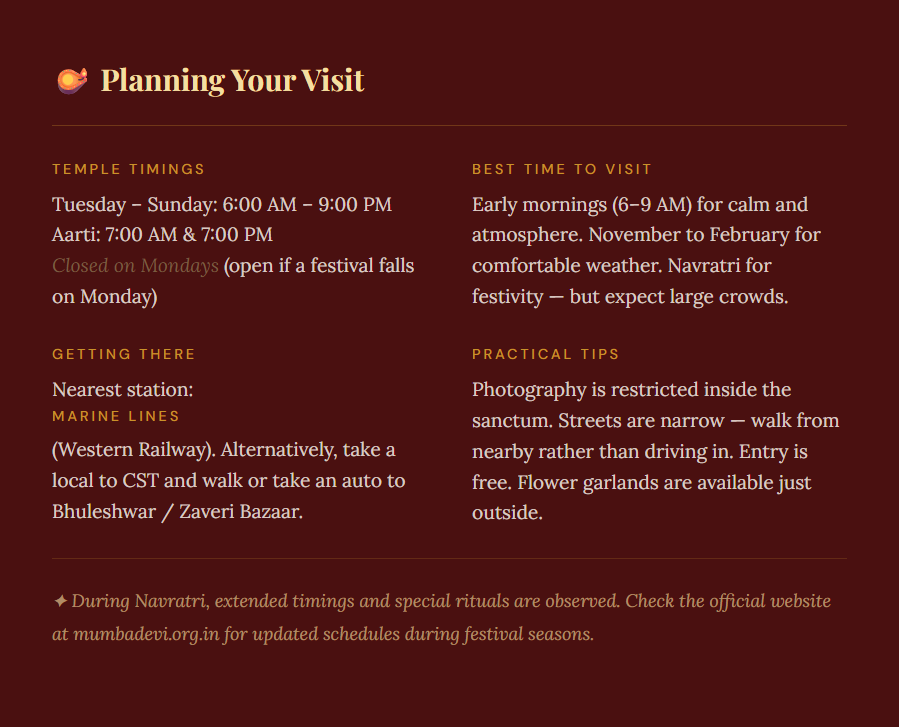
The temple is open six days a week (closed on Mondays, unless a festival falls on that day). It is free to enter. It asks nothing of you except that you remove your shoes before you step inside — a sign of respect that is universal across Hindu, Jain, Sikh, and many Muslim sacred spaces in India. You do not need to be Hindu to visit, to look, or to feel something in the presence of a tradition this old and this continuous.
Useful Links :
Planning your visit? These official resources may help you before you go.


Comments