


What Nobody Tells Foreign Tourists About Mumbai Local Trains: The Unwritten Rules

Updated: Jul 7

The Lifeline of Mumbai: Where Every Iconic Journey Begins
Imagine a city so alive, so relentlessly energetic, that even its trains feel like a living organism. That is exactly what the Mumbai Local Train is — not just a mode of transport, but the very pulse of one of the world's most dynamic cities.
Every single day, over 8 million passengers travel across Mumbai's suburban railway network. That number is staggering. It is more than the entire population of many countries. Office workers, college students, vegetable vendors, tourists, and families — everyone shares the same coaches, the same platforms, and the same mad rush to catch the next train.
The roots of this railway stretch all the way back to 1853, when India's very first passenger train made its historic journey between Bombay (now Mumbai) and Thane. That single route eventually grew into one of the most complex and efficient suburban rail systems anywhere on the planet, covering approximately 450 kilometres of track and running over 2,300 daily services across the city.
At Bharatithi, we believe that no visit to Mumbai is truly complete without stepping onto a local train at least once. Yes, it may look overwhelming from the outside. But trust us — with a little preparation, it becomes one of the most memorable and genuinely authentic experiences you will have in India.
Understanding the Three Main Lines
Before you even reach a station, knowing which line you need will save you enormous confusion.
1) Western Line
This route runs from Churchgate in South Mumbai all the way up through Bandra, Andheri, Borivali, and beyond to Virar. If you are visiting popular tourist spots, sea-facing neighbourhoods, or want to explore Mumbai's western suburbs, this is your line.
2) Central Line
Starting from Chhatrapati Shivaji Maharaj Terminus (CSMT), the Central Line heads towards Thane, Kalyan, and further branches towards Kasara and Khopoli. It is one of the busiest commuter routes in the world. Note that at Kalyan, the line splits — so always confirm which branch your destination falls on.
3) Harbour Line
Also originating from CSMT but using separate dedicated platforms, the Harbour Line connects South Mumbai with Navi Mumbai, Vashi, Belapur, and Panvel. If you are staying in Navi Mumbai, this line is your gateway to the city.
A useful Tip: at CSMT, the Harbour Line uses its own platforms, completely separate from the Central Line tracks. Do not confuse the two when you arrive. Find all these routes easily in the M-Indicator app under the "Map" section.
Reading Train Boards: Don't Panic
Walking onto a busy Mumbai platform for the first time can feel like arriving at an airport where nobody speaks your language. Electronic display boards hang above platforms showing train destinations, platform numbers, and whether the train is Fast or Slow.
Here is a simple explanation:
Fast trains skip smaller stations and stop only at major junctions. They cover long distances more quickly — not because they travel faster, but because they make fewer stops.
Slow trains stop at every station along the route.
The board will also show the Final Destination of each train. Always check that the destination is beyond your stop, not before it. And always confirm the platform number on the board — never assume it is the same platform you used last time.
Platform Awareness: Stay Alert
One thing that surprises many first-time visitors is that platforms can change without much warning. A train you expected on Platform 3 may suddenly appear on Platform 5.
Never assume. Always check.
The best habit to develop before travelling is to verify your train's platform number using the M-Indicator app (more on this shortly) or by listening carefully to station announcements. Mumbai stations do make public announcements in Hindi, Marathi, and often English, so keep your ears open.
Standing behind the yellow safety line on the platform edge is not just a suggestion — it is essential for your safety. Trains arrive quickly and depart just as fast.
M-Indicator: Download It Before You Do Anything Else

If there is a single piece of advice our team at Bharatithi would give every foreign tourist travelling by Mumbai Local, it is this: download the M-Indicator app immediately.
This free application is used by millions of Mumbai commuters every single day — from first-time riders to people who have been taking the same train for twenty years. It is that useful.
Here is what M-Indicator gives you:
✅ Train schedules for all three lines
✅ Platform numbers before you reach the station
✅ Fast and Slow train identification so you board the right service
✅ Fare information between any two stations
✅ Route planning from point to point
✅ Station guides with coach position details
The app functions even in areas with limited connectivity, making it incredibly practical during your journey. Think of it as your personal Mumbai railway expert sitting in your pocket.
Buying Your Ticket
Travelling without a valid ticket is not an option — ticket checking staff (known locally as TCs or Ticket Examiners) patrol trains and platforms regularly, and fines are issued on the spot.
Here are your ticketing choices:
Ticket counters at every station — simply tell the staff your destination and class (First or Second). Queues can be long during rush hours.
Automatic Ticket Vending Machines (ATVMs) — available at most stations, faster than queues, and straightforward to use.
UTS Mobile App — allows digital ticket purchase. Note that tickets must generally be purchased before entering station premises due to location-based rules. Activate your ticket before boarding.
Return tickets — if you are travelling back the same day, a return ticket is slightly cheaper than buying two singles.
Daily passes — if you plan multiple journeys in a day, a day pass can offer good value.
Always keep your ticket until you exit the destination station. You will need it at the exit gate.
Coach Types Explained Simply
Not every coach on a Mumbai Local is the same. Here is a quick guide so you board correctly:
1) Second Class (General) — The most common and affordable coach. Busy during peak hours, perfectly manageable at quieter times. Minimum fare starts at just ₹5.
2) First Class — Less crowded, more comfortable, costs more but still far cheaper than a taxi. Highly recommended for foreign tourists, especially during busier periods.
3) Ladies Coach — Reserved exclusively for women. Female passengers are encouraged to use these coaches. Male passengers must not board them.
4) Divyang Coach — Reserved for passengers with disabilities. Clearly marked and identified by distinct audio signals at some stations. Do not occupy these spaces.
5) Luggage/Vendor coaches — Some trains carry a designated space for luggage and vendors at the ends of the rake.
Look carefully at the markings on the platform and on the coach exterior before stepping in.
AC Local Trains: The Comfortable Alternative
Mumbai now operates AC Local Trains on both the Western and Central/Harbour lines, and they are a wonderful option for tourists who prefer a more comfortable ride.
Unlike the traditional open-door coaches, AC Locals have fully enclosed, air-conditioned interiors, automatic doors, and a noticeably quieter atmosphere. They are also vestibuled — meaning all coaches are interconnected internally, so passengers can move through the entire train to find space.
The trade-off is price. While a regular Second Class fare can start at around ₹5, the minimum fare on an AC Local begins at approximately ₹35, rising with distance. Still extremely affordable by international standards, and well worth considering for a longer journey or a more relaxed experience.
Rush Hours: When to Stay Away
Mumbai's rush hours are not something you want to walk into unprepared.
Morning peak: approximately 7:30 AM to 10:30 AM
Evening peak: approximately 5:30 PM to 8:30 PM
During these windows, trains reach what railway planners call a "Super-Dense Crush Load" — meaning the coaches carry far more passengers than their designed capacity. The experience is intense even for regular commuters. For a tourist with luggage, a camera, and no experience of the system, it can be genuinely overwhelming.
Avoid these hours for sightseeing trips wherever possible.
Safest Times for Tourists to Travel
The good news is that outside rush hours, Mumbai Local Trains are surprisingly pleasant.
Mid-morning (10:30 AM to 12:00 PM) — Comfortable, manageable crowds
Afternoon (12:00 PM to 4:30 PM) — Often the quietest window of the day
Weekends — Especially Sunday, when most office commuters are at home
These windows give you the chance to actually enjoy the journey — watch the city scroll past the window, observe everyday life, and perhaps even snag that prized window seat.
Sunday Mega Block: Plan Ahead
Speaking of Sundays — there is something you absolutely must know before planning a Sunday rail journey in Mumbai.
Almost every Sunday, sections of the railway network are taken partially or fully offline for scheduled maintenance work. These are officially called Mega Blocks, and they are essential for keeping the tracks safe given the enormous daily traffic the system handles.
During a Mega Block, certain trains may be cancelled, delayed, or rerouted. For a tourist who did not know about this, it can cause real confusion.
The solution is simple: check M-Indicator the evening before any Sunday journey. Mega Blocks are announced in advance and the app reflects updated schedules. Alternatively, keep a taxi or auto-rickshaw as a backup plan for Sunday mornings.
Ganapati Festival: Crowds, Colour, and Culture
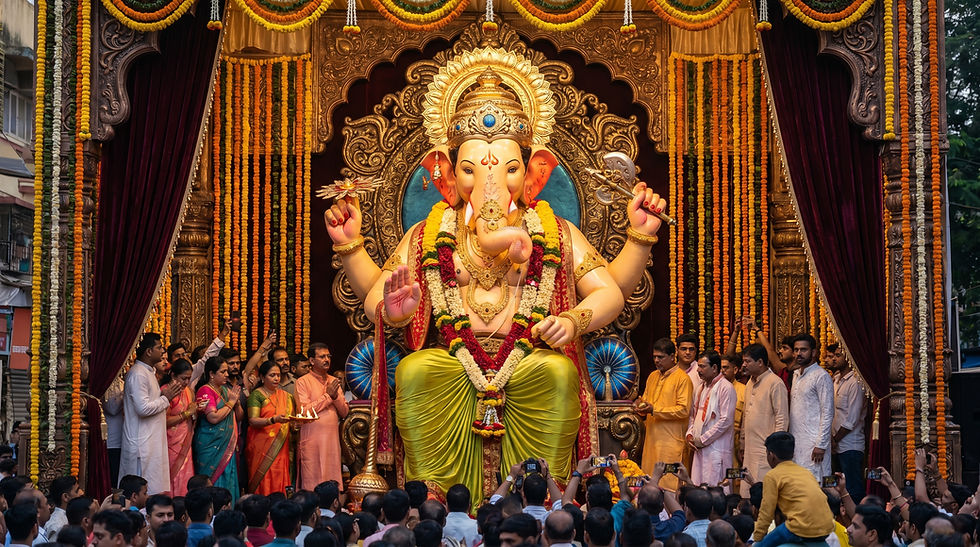
If you happen to be in Mumbai during the Ganapati Festival (Ganesh Chaturthi, typically in August or September), the local trains offer an experience unlike anything else in the world.
Thousands of families travel with beautifully decorated Lord Ganesha idols, surrounded by drums, chants, flowers, and an atmosphere of pure devotion. One of the most surprising sights for foreign visitors is that many passengers place the Ganesh idol inside the train coach itself, where families and devotees sing Ganesh Aarti, clap together, and offer prayers during the journey. For a few unforgettable moments, an ordinary train coach transforms into a moving place of celebration and devotion.
The coaches overflow with colour, music, joy, and community spirit, creating one of the most visually spectacular cultural experiences you can witness in India.
However, the crowds during this period reach extraordinary levels—even by Mumbai's standards. If you enjoy lively cultural celebrations, it is an unforgettable experience. If you prefer quieter travel, consider using the Metro, taxis, or travelling during off-peak hours on festival days.
The Famous Window Seat (A Sacred Institution)
For many Mumbai commuters, the window seat is more than just a seat—it's a prized reward.
After a long day, feeling the cool breeze through the open window as the city rushes by is a simple joy that regular commuters cherish. Many even wait for a specific window seat facing the direction of travel, where the breeze hits your face throughout the journey.
People arrive early, plan their boarding position, and patiently wait for the right passenger to get off—all for that perfect seat. It is competitive, completely genuine, surprisingly charming, and often hilarious.
Essential Tips for Foreign Tourists
Before you board your first Mumbai local, read through this quick checklist:
✅ Download M-Indicator before leaving your hotel
✅ Travel between 10:30 AM and 4:30 PM whenever possible
✅ Choose First Class or AC Local if you prefer personal space
✅ Buy your ticket before entering the platform
✅ Stand behind the yellow line on every platform
✅ Let passengers exit first before you attempt to board
✅ Keep your bag in front of you in crowded coaches
✅ Do not enter Ladies or Divyang coaches unless you are entitled to use them
✅ Check for Sunday Mega Blocks before any weekend journey
✅ Keep your ticket until you have exited the destination station
✅Carry water, especially during Mumbai's hot and humid summer months
✅Listen to announcements — they carry platform and schedule information
Final Thoughts: Catch the Rhythm of Mumbai
The Mumbai Local Train is not simply infrastructure. It is an experience, a culture, a philosophy of urban life compressed into steel, noise, and constant motion.
Yes, the first time you walk onto a crowded platform with trains thundering in and hundreds of people moving in every direction, it will feel chaotic. But chaos in Mumbai has its own extraordinary logic. Watch carefully, and within minutes you will start to see the pattern — the unspoken rules, the quiet courtesy beneath the apparent madness, the rhythm that keeps 8 million people moving every single day without fail. People often say Mumbai never sleeps—and the local train schedule reflects that. The network pauses for only a brief overnight maintenance window of roughly 2–3 hours before the city's lifeline starts running again in the early morning.
Ride it once, and you will understand Mumbai in a way that no museum, no tour bus, and no guidebook can ever fully explain.
At Bharatithi, we are here to help you explore India with confidence, curiosity, and the right information in your hands. Mumbai's local train is waiting for you — and now, so is your window seat.



Comments