


7 Extraordinary Indian Villages That Will Leave You Speechless — Journey Beyond the Ordinary


Introduction: The India Most Travelers Never See
When most international travelers think of India, their minds travel to the Taj Mahal, the pink streets of Jaipur, the backwaters of Kerala, or the golden beaches of Goa. And while those destinations are absolutely magnificent, we at Bharatithi believe that the true soul of India lives somewhere far quieter — tucked between misty hills, along forgotten coastlines, and inside villages where time seems to follow its own gentle rhythm.
India is home to more than 600,000 villages. Most of them will never appear in a travel magazine. But a handful of these villages are so extraordinary, so genuinely unlike anything else on Earth, that they deserve a place on every serious traveler's bucket list.
We have personally explored and curated a collection of seven such villages — each one carrying a story that challenges your expectations, broadens your understanding of human culture, and leaves you with memories that simply cannot be replicated anywhere else in the world. These 7 Extraordinary Indian Villages Will Leave You Speechless when you visit them.
Whether you are fascinated by nature, spirituality, mystery, wildlife, or simply the beauty of communities living on their own extraordinary terms, these seven destinations will move you deeply.
Let us take you there.
1. Mawlynnong, Meghalaya — Where Cleanliness Is a Way of Life

📍 Location: East Khasi Hills District, Meghalaya, Northeast India
🗓️ Best Time to Visit: October to April
Imagine arriving at a village so immaculately clean that every pathway feels freshly swept, every garden bursts with colour, and not a single piece of litter dares to rest on the ground. That is Mawlynnong — a small community nestled deep in the misty hills of Meghalaya, widely celebrated as one of Asia's cleanest villages. This Village is approximately 90 km from Shillong.
What makes Mawlynnong truly special is not simply the cleanliness itself, but the community spirit behind it. Every resident, from young children to elderly grandparents, participates in maintaining the village. Handcrafted bamboo dustbins are positioned throughout the lanes. Organic waste is carefully composted. Plastic is strongly discouraged.
We at Bharatithi encourage you to walk slowly through Mawlynnong and observe how a community can transform cleanliness into a cultural identity. Beyond the village itself, you can explore the remarkable Living Root Bridges — extraordinary natural structures formed over many decades by carefully guiding the roots of rubber fig trees across streams. A bamboo skywalk also offers breathtaking panoramic views extending all the way toward Bangladesh.
Mawlynnong is also part of the traditional Khasi matrilineal society, where ancestry and family identity are passed through the mother's line — a fascinating cultural detail that adds depth to your visit.
We recommend: Spending a full day here. Consider booking a local homestay to experience the village's warmth firsthand. Avoid visiting during the heavy monsoon months of June to September, as the paths can become slippery and difficult.
2. Bhandardara, Maharashtra — The Hidden Lakeside Sanctuary
📍 Location: Ahilyanagar District, Maharashtra
🗓️ Best Time to Visit: June to September for waterfalls and greenery; October to February for trekking, camping, and stargazing
Nestled within the Sahyadri mountain ranges of Maharashtra, Bhandardara is the kind of destination that genuinely surprises first-time visitors. Often called the "Switzerland of Maharashtra" by those who know it well, this village is surrounded by rolling green hills, ancient forts, and the beautiful Arthur Lake at its heart. This village is approximately 165 km from Mumbai.
During the monsoon season, the landscape transforms dramatically. Waterfalls cascade down rocky cliffs, the hillsides turn impossibly lush, and the air carries the fresh scent of rain-soaked earth. Randha Falls and the unusual Reverse Waterfall at Samrad — where strong winds push the falling water back upward — are genuinely mesmerising sights.
For those who love adventure, nearby Mount Kalsubai stands as the highest peak in Maharashtra and rewards hikers with sweeping valley views. Bhandardara is also one of the finest stargazing destinations in the entire region, thanks to its minimal light pollution and wide open night skies.
At Bharatithi, we particularly love Bhandardara for its extraordinary variety — it offers something meaningful regardless of which season you visit. The Wilson Dam, built more than a century ago, adds a quiet layer of historical interest to your exploration.
We recommend: Camping beside Arthur Lake for an unforgettable night under the stars. For those travelling in May or early June, the seasonal firefly festivals in the surrounding forests are a genuinely magical experience.
3. Shani Shingnapur, Maharashtra — The Village That Trusts the Divine

📍 Location: Ahilyanagar District, Maharashtra
🗓️ Best Time to Visit: October to March
In a world where security cameras, electronic locks, and alarm systems have become standard features of daily life, the village of Shani Shingnapur presents a quietly radical alternative. For centuries, many homes in this village have been built and lived in without traditional door locks — a practice rooted in the community's profound faith in Lord Shani, the Hindu deity associated with justice and cosmic balance. This village is approximately 73 km from Ahilyanagar.
The story behind this tradition is deeply compelling. According to local belief, Lord Shani himself promised to protect the village, and generations of residents have honoured that covenant. The village Shani Temple features a striking open-air black stone idol — an unusual and powerful sight for any visitor.
We at Bharatithi encourage you to approach Shani Shingnapur with genuine curiosity and respectful openness. This is not merely a curiosity for photographs — it is a living expression of a community's collective faith and its relationship with trust, honesty, and divine protection. Please dress modestly and observe local customs during your visit.
We recommend: Visiting on a Saturday, when devotees gather in large numbers and the spiritual atmosphere is particularly vibrant. The festival of Shani Jayanti is also an exceptional time to experience the village's energy.
4. Kodinhi, Kerala — India's Remarkable Twin Village
📍Location: Malappuram District, Kerala
🗓️ Best Time to Visit: October to February
Kodinhi is one of those places that makes you quietly wonder whether the universe occasionally enjoys bending the rules of biology. In this peaceful agricultural village in Kerala, the rate of twin births is approximately six times the global average. In a community of around 2,000 families, researchers have documented more than 400 pairs of twins — and the numbers continue to grow each year. This village is approximately 15 km from Malappuram town; 25 km from Calicut International Airport.
Walking through Kodinhi's local school is a genuinely surreal experience. You encounter pair after pair of children with identical features, sitting side by side in classrooms. Scientists from around the world have studied the village's water, genetics, and diet, yet no single confirmed explanation has emerged. The mystery remains beautifully unsolved.
Beyond the fascinating biological phenomenon, Kodinhi is a warm, welcoming, and deeply traditional Kerala village. The surrounding landscape is lush and peaceful, the local hospitality is genuine, and the community celebrates its unique identity with quiet pride.
At Bharatithi, we believe Kodinhi offers something rare — the opportunity to witness a genuine global mystery in its natural setting, while also connecting with the everyday rhythms of Kerala village life.
We recommend: Always ask for permission before taking photographs of residents. Approach your visit with respectful curiosity rather than treating the community as a spectacle.
5. Devmali, Rajasthan — The Village That Chose a Different Age
📍 Location: Near Beawar, Rajasthan
🗓️ Best Time to Visit: October to March
In a rapidly modernising world, the Gujjar community of Devmali in Rajasthan has made a conscious and remarkable choice — to remain deeply rooted in their traditional way of life, guided by the values and mandates of Lord Devanarayan, a revered local deity considered an incarnation of Lord Vishnu. This village is approximately 60 km from Ajmer.
Every home in Devmali is built from mud and natural materials. No concrete structures exist within the village boundaries. The community follows strict codes — no meat, no alcohol, and a deep commitment to living in harmony with their traditional values. What is particularly striking is that this is not a choice driven by economic necessity. Even wealthy families and officials who work in cities return to live in traditional mud homes within the village.
The land itself — approximately 4,000 bighas — is registered in the name of the deity, ensuring it can never be sold for personal profit. Visitors can interact with the community, witness traditional architecture, and gain a profound understanding of how deeply held spiritual beliefs can shape every aspect of daily life.
At Bharatithi, we present Devmali as a destination for culturally curious travelers who appreciate the beauty of communities living authentically by their own chosen values.
We recommend: Respecting the village's customs completely. Alcohol and non-vegetarian food are not permitted within the village. Dress conservatively and engage with genuine openness and respect.
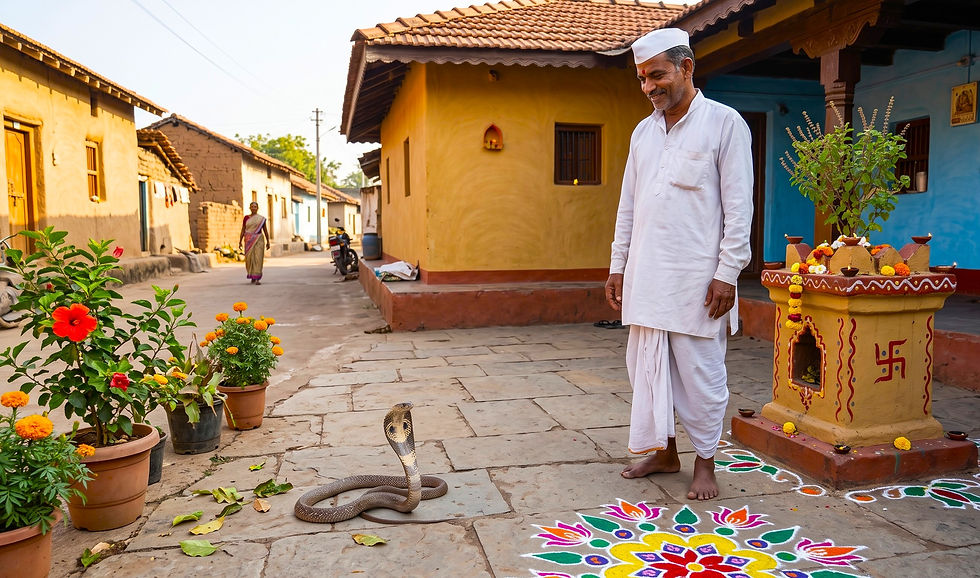
6. Shetphal, Maharashtra — Where Cobras Share the Home
📍 Location: Solapur District, Maharashtra
🗓️ Best Time to Visit: October to February for comfortable weather.
If there is one village on this list most likely to make your jaw drop, it may well be Shetphal. In this quiet settlement in Maharashtra's Solapur district, Indian cobras are not feared or driven away — they are welcomed, respected, and regarded as sacred members of the community. This village is approximately 200 km from Pune.
Traditional homes in Shetphal are built with a dedicated hollow alcove — known locally as a Devasthanam — where cobras may rest freely. These spaces are incorporated into the architectural plans of new homes as a matter of course. Children grow up playing beside these spaces, and the village maintains an extraordinary safety record — according to local accounts, no death from snakebite has been recorded within the village.
The relationship between the community and the cobras reflects a sophisticated understanding of ecological balance. Residents recognize that cobras protect agricultural fields by hunting the rats that damage crops. This is ancient wisdom expressed as daily living.
We at Bharatithi recommend visiting Shetphal during the Nag Panchami Festival in July or August, when the devotion and community celebration are at their most vibrant. Throughout the rest of the year, October to February offers the most comfortable weather.
We recommend: Always visit with local guidance. Do not disturb or provoke any wildlife you encounter. Approach the village with genuine respect for both its residents and their remarkable relationship with nature.
7. Velas Village, Maharashtra — A Turtle's Journey to the Sea
📍 Location: Ratnagiri District, Maharashtra
🗓️ Best Time to Visit: March to April for turtle hatchlings
Of all the villages we have explored for you, Velas may carry the most quietly moving story. This small coastal village on the Konkan Coast of Maharashtra has become a celebrated model of community-led wildlife conservation — and it all centers on the Olive Ridley sea turtle. This village is approximately 220 km from Mumbai.
Every year, Olive Ridley turtles return to the beaches near Velas to lay their eggs. Conservation volunteers carefully monitor and protect the nests, relocating eggs to protected hatcheries where necessary, shielding them from predators. When the hatchlings finally emerge and make their tiny, determined journey toward the Arabian Sea, it is one of the most emotionally resonant natural spectacles you are likely to witness anywhere in the world.
The annual Velas Turtle Festival, held between March and April, draws visitors from across India and increasingly from abroad. The economic model built around the festival is particularly inspiring — visitors stay in family homestays, eat traditional Konkani meals, and support local livelihoods directly. The community's income is now tied to the protection of the beach rather than the exploitation of it.
Beyond the turtles, Velas offers peaceful beaches, charming traditional Konkani architecture, and the kind of unhurried coastal atmosphere that is increasingly difficult to find.
At Bharatithi, we consider Velas one of our most treasured recommendations — a destination that demonstrates how tourism, when approached responsibly, can genuinely protect the natural world.
We recommend: Plan your visit specifically for March or April and arrive early — hatchling releases typically occur around sunrise and sunset. Book your homestay well in advance, as the festival period fills up quickly.
Our Final Thought: Travel That Goes Deeper
India's most extraordinary stories are not always found in its famous cities or its iconic monuments. They live in places like these seven villages — in the spotless lanes of Mawlynnong, in the unlocked doorways of Shani Shingnapur, in the mysterious classrooms of Kodinhi, and on the moonlit beaches of Velas where tiny turtles meet the ocean for the very first time.
At Bharatithi, we believe that travel becomes truly meaningful when it moves beyond sightseeing and becomes genuine discovery. These villages invite you not just to observe, but to reflect — on community, on faith, on our relationship with nature, and on the extraordinary diversity of ways in which human beings choose to live.
We hope this guide inspires you to look beyond the familiar and explore the India that most travelers never find.
Happy exploring — Bharatithi


Comments