


Indore Travel Guide: India's Cleanest City, Street Food Capital & Must-Visit Attractions

Updated: Jul 22

The City Nobody Warned You About
Here's a question worth asking: What if the best Indian city you've never heard of is also the one you'll remember the longest?
Most international travelers land in Delhi, rush to Agra for the Taj Mahal, swing through Jaipur for the palaces, and call that "India." It's a fine trip. But it leaves out an entire country's worth of experiences — including a city in the middle of the subcontinent that has been quietly doing things no other Indian city can claim.
That city is Indore.
Located in the state of Madhya Pradesh in central India, Indore sits at the geographic heart of the country. It has held the title of India's cleanest city for seven consecutive years. It is the only city in India with both an IIT (Indian Institute of Technology) and an IIM (Indian Institute of Management) — two of the country's most prestigious academic institutions. It has a food culture so deep and distinctive that locals argue about the best snack stalls the way Italians debate espresso.
And yet, for most foreign travelers, Indore doesn't even appear on the radar.
At Bharatithi, we think that's a genuine missed opportunity — and this guide is our attempt to change that. Whether you're building your first India itinerary or looking to go somewhere genuinely off the standard tourist trail, Indore deserves a serious look.
Quick Facts About Indore
Before you pack your bags, here's everything you need at a glance:

History of Indore: From Ancient Trade Hub to Modern Smart City
Indore's story is older than most people realize.
The area traces its origins back to around 465 CE, when it was known as Indrapura — a settlement with roots in the Gupta era, one of the great dynasties of ancient India. For centuries, the location made it a natural junction for trade caravans moving between northern and southern India.
The turning point came in the 18th century, when Indore became the capital of the Holkar dynasty under the vast Maratha Empire. The Marathas were a powerful Hindu warrior confederation that controlled large parts of India during this period, and the Holkars were one of their most capable ruling clans.
Maharani Ahilyabai Holkar — The Queen Who Built a City's Soul
If you spend more than a day in Indore, you will hear this name repeatedly: Ahilyabai Holkar.
She ruled from 1767 to 1795, and her legacy is almost impossible to overstate. Under her governance, Indore became a model of just and compassionate leadership at a time when such things were far from guaranteed. She invested in infrastructure, supported local craftspeople, rebuilt or restored temples across the entire Indian subcontinent — including sacred sites in Varanasi, Somnath, and Ujjain — and earned a reputation for fairness that still echoes through local culture today.
She is not a distant historical figure here. Her image appears on government buildings. Streets carry her name. The city's main airport is named after her. To understand Indore is, in part, to understand the values she embedded in this place centuries ago.
Why Indore Is Famous: The Short Version
People visit Indore for different reasons, but a few things consistently stand out:
Cleanliness: Seven consecutive years as India's top-ranked clean city under the national Swachh Survekshan survey. This isn't just cosmetic — the city operates Asia's largest bio-CNG plant, which processes 550 tons of waste daily and converts organic material into fuel for city transport.
Street food: Consistently regarded as one of India's greatest street food destinations. The variety and quality are remarkable. E.g. Indori Poha.
Architecture: Royal palaces, glass-covered temples, and colonial-era grandeur all within a few kilometers of each other.
Location: A perfect base for exploring several remarkable destinations across central India — all within a few hours.
Livability: Ranked among India's most livable cities. Clean air, organized infrastructure, and a genuine sense of civic pride make it comfortable for visitors too.
The Food Guide: Why Indore Is in a League of Its Own
Let's be honest. For many travelers, the food is the point.
Indore is not just a good food city. It is a city where food is practically a religion, where people will drive across town for a specific version of a single snack, and where the question "have you eaten?" functions as both a greeting and a genuine expression of care.
The vast majority of Indore's famous dishes are vegetarian. If you don't usually eat vegetarian food, this is the place that might change your perspective permanently.
1) The Poha and Jalebi

The classic Indore morning begins with Poha — flattened rice cooked with mustard seeds, curry leaves, onions, green chilies, and turmeric, then topped with fresh coriander, a squeeze of lemon, and crunchy fried noodles called sev. It's light, savory, and somehow deeply satisfying.
Alongside Poha comes Jalebi — a spiral-shaped fried sweet soaked in sugar syrup, served hot. The combination sounds unusual until you try it, and then it makes complete sense. The sweet and savory balance is the whole point.
This breakfast combination is so embedded in local identity that "Poha-Jalebi" has become shorthand for Indore itself.
2) Sabudana Khichdi

Sabudana Khichdi is made from tapioca pearls — small, round, translucent beads soaked until soft, then cooked with peanuts, cumin, green chilies, and lemon. It has a slightly chewy texture and is mildly spiced. Traditionally eaten during religious fasting periods, it has crossed over into everyday eating because it's genuinely delicious.
3) Kachori

Kachori here deserves special mention. A kachori is a deep-fried pastry with a crisp shell, typically filled with spiced lentils or peas. Indore's version — particularly the Batla Kachori — has an unusually flaky, layered exterior and a filling that's richer and more complex than what you'll find elsewhere.
4) Shikanji

Shikanji is a drink with an Indore personality all its own. Elsewhere in India, shikanji is essentially lemonade. In Indore, it's a thick, chilled milk-based drink made with yogurt, dry fruits, saffron, and aromatic spices. Think of it as a cold dessert in a glass — intensely flavorful, a little sweet, a little fragrant.
5) Dal Bafla
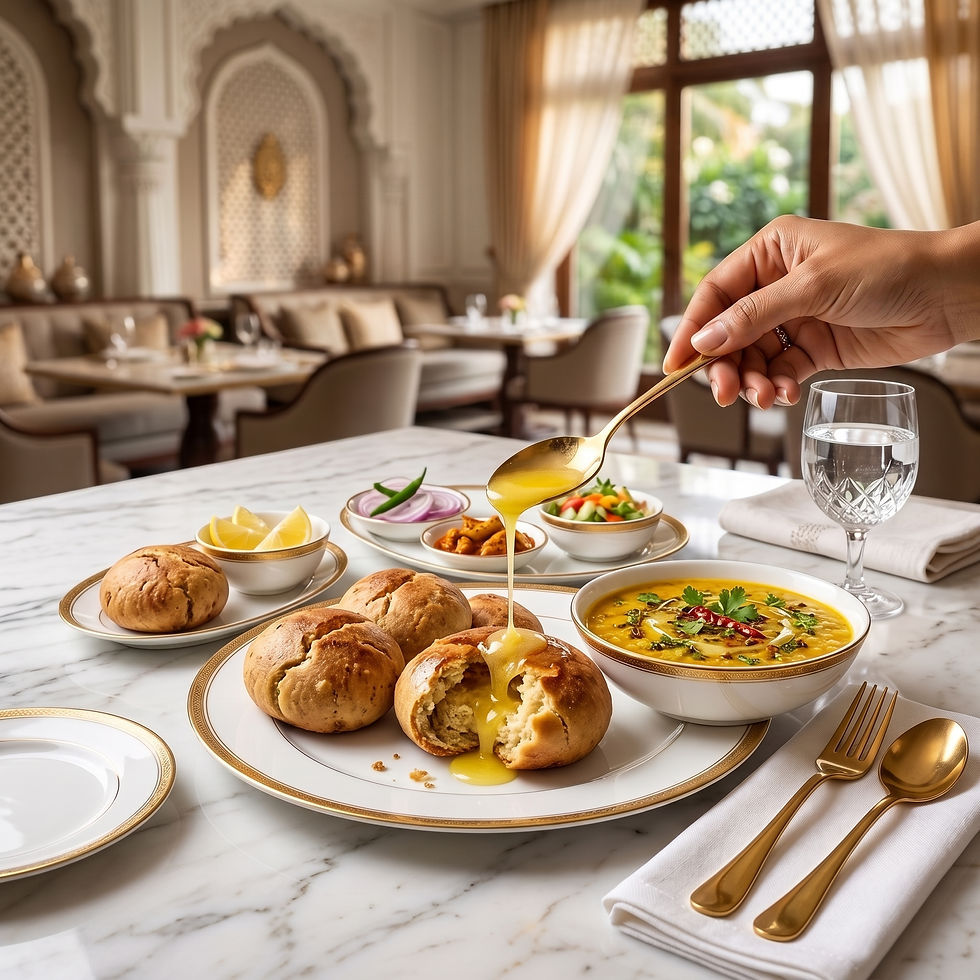
Dal Bafla is the heartier, more filling option. Bafla are wheat dough balls that are first boiled, then baked or grilled until they develop a firm crust. They're served with dal (lentil curry) and ghee for dipping. Think of it as a more complex cousin of the famous Rajasthani Dal Baati, but with its own distinct character.
The Famous Food Streets
Sarafa Bazaar is the experience every visitor talks about afterward. During daylight hours, this is a traditional gold and jewelry market. When the sun goes down, everything changes. The jewelry shops pull down their shutters, and within an hour, hundreds of food stalls appear in their place. The street fills with light, noise, and the smell of frying, roasting, and simmering food. Vendors serve everything from Bhutte Ka Kees to hot milk sweets to savory snacks, and the whole thing runs until the early hours of the morning. It's considered India's most famous night food market, and the energy is unlike anything else.
Chappan Dukan — literally "56 shops" — is the daytime counterpart. This stretch of eateries and stalls has recently been upgraded into what locals call a Smart Food Street, with cleaner surroundings and more organized seating. The range here is impressive: traditional snacks, regional sweets, fusion dishes, and fresh juices.
Practical food tips for foreign visitors:
Eat where it's busy — high turnover means fresher food
Carry hand sanitizer; most stalls won't have washing facilities nearby
Start mild and build up to spicier items if you're not used to Indian spices
Most street food is very affordable — expect to spend ₹20–100 per item
If your stomach is sensitive, stick to cooked, hot food rather than raw garnishes initially.
Best Tourist Attractions in Indore
Rajwada Palace
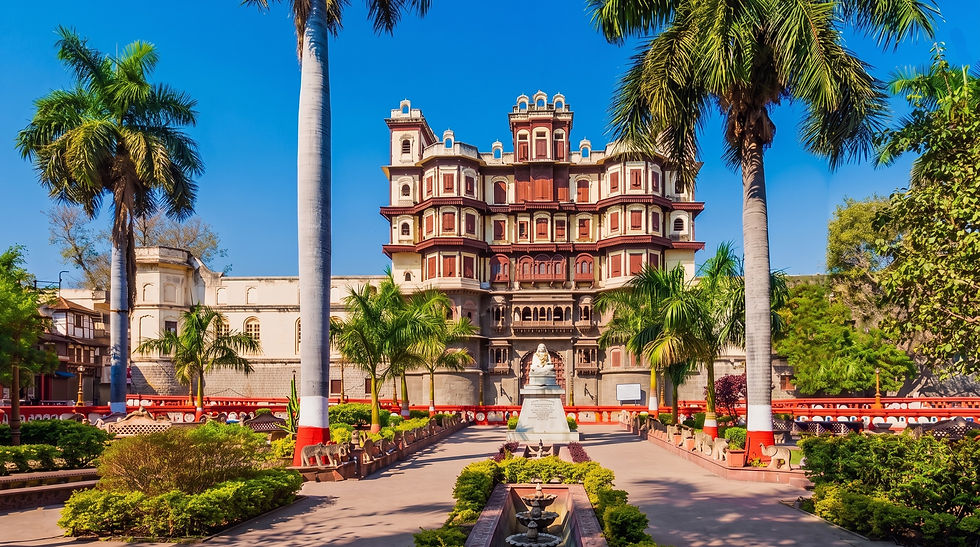
Standing at the center of the old city, Rajwada is the kind of building that stops you in the middle of a sentence. This seven-story structure was built by the Holkar rulers, and its architecture is genuinely unusual — the lower floors are constructed from stone in a Mughal style, while the upper levels shift to timber-framed construction typical of Maratha design, with hints of European decorative influence layered throughout.
The palace has had a complicated history — fire damaged sections of it over the centuries — but what stands today is still remarkable. The interior has been partially restored. In the evening, a light and sound show brings the palace's history alive in Hindi and English, which is worth catching if you're visiting after dark.
Best time to visit: Early morning for photography, evening for the light show.
Who should visit: History lovers, architecture enthusiasts, first-time visitors.
Photography tip: The facade photographs beautifully from across the square — arrive before 8am for soft light without crowds.
Lal Bagh Palace
If Rajwada tells the story of Holkar military power, Lal Bagh tells the story of Holkar luxury. Completed in 1921, this palace was the residence of the later Holkar rulers, and the interiors reflect an era of confident, cosmopolitan taste. Italian marble floors, Persian-style carpets, grand chandeliers, and — remarkably — entrance gates that were modeled directly on the gates of Buckingham Palace in London.
Walking through Lal Bagh is a slightly surreal experience. You move through rooms that feel simultaneously very Indian and very European, which is precisely the point — the Holkar rulers were deeply engaged with the wider world while remaining rooted in their own traditions.
Best time to visit: Morning, when the light falls through the large windows.
Visiting time: Allow 1.5–2 hours
Interesting fact: The palace grounds include sprawling gardens that are lovely for a slow walk.
Kanch Mandir (Glass Temple)
The exterior gives nothing away. Kanch Mandir looks, from the street, like a relatively modest building. Step inside, and your eyes need a moment to adjust to what they're seeing.
Every surface — floor, walls, columns, ceiling — is covered in multicolored glass and mirror work. The geometric patterns are extraordinarily intricate. The reflections multiply and layer until the interior feels almost infinite. This is a Jain temple (Jainism is an ancient Indian religion emphasizing non-violence and spiritual discipline), and the atmosphere inside is deeply peaceful despite the visual extravagance.
Who should visit: Anyone interested in religious art, craft traditions, or unusual visual experiences.
Photography tip: Photography inside may be restricted — always ask before pointing your camera .
Practical note: Remove shoes before entering, as with all Indian temples
Khajrana Ganesh Temple
This temple is dedicated to Lord Ganesha. Ganesha is associated with new beginnings, removing obstacles, and wisdom — which is why people visit before starting a new job, business, or journey.
Khajrana draws enormous numbers of worshippers, particularly on Wednesdays and during festivals. Even if religious practice isn't your personal interest, the atmosphere here — the smell of flowers and incense, the sound of bells and prayers, the sight of families completing rituals together — is a genuine window into everyday Hindu devotion.
Best time to visit: Early morning or weekday evenings (avoid major festival days if you prefer smaller crowds)
Visiting time: 30–45 minutes
Central Museum of Indore
Housed in a handsome colonial-era building, the Central Museum holds an impressive collection of sculptures, ancient coins, inscriptions, weaponry, and archaeological finds from across Madhya Pradesh. For anyone interested in the deep history of central India — from the ancient Gupta period through the medieval era to the colonial period — this museum provides excellent context.
Visiting time: Allow 1.5–2 hours
Tip: Hire a guide at the entrance if available — the context they provide makes the collection significantly more meaningful.
Annapurna Temple
This temple is dedicated to the goddess Annapurna, who in Hindu tradition is the deity of food, nourishment, and abundance. The entrance is flanked by four large elephant sculptures, which are considered symbols of strength and auspiciousness (good fortune). The temple's architecture is ornate and colorful, and the surrounding area has a calm, neighborhood feel.
Visiting time: 30 minutes
Best for: Morning visits, when the temple atmosphere is most peaceful.
Gomatgiri
A Jain pilgrimage site set on a hill on the outskirts of Indore, Gomatgiri features a 21-foot statue of Lord Gommateshwara and 24 smaller shrines representing the 24 Tirthankaras — the enlightened teachers central to Jain belief. The hilltop setting offers good views over the surrounding area, and the atmosphere is serene.
Best for: Those interested in Jain heritage, photography, peaceful hilltop walks
Day Trips from Indore: Central India Is Your Playground
One of Indore's most underrated qualities is its position as a gateway to some of central India's most extraordinary destinations.
Ujjain — The Sacred City (55 km, approximately 1 hour)
Ujjain is one of Hinduism's seven sacred cities, a place where pilgrims have been arriving for thousands of years. The Mahakaleshwar Temple here is one of the twelve Jyotirlingas — the most sacred Shiva temples in India (Shiva is one of Hinduism's principal deities, associated with destruction and transformation in the cosmic cycle). The temple's early morning ritual, called the Bhasma Aarti, is a genuinely arresting experience — though it requires advance planning and an early start.
Why visit: Ancient religious atmosphere, beautiful ghats (stepped riverbanks) along the Shipra River, historical significance
Recommended: Full day trip, leaving Indore by 6–7am
Mandu — The Forgotten Romance (approximately 100 km, 2 hours)
Mandu is a revelation. This ancient fortified city sits on a plateau in the Vindhya hills and contains some of the finest examples of Afghan-style architecture in India. The ruins here include grand mosques, pavilions, step-wells, and palaces — most notably the Jahaz Mahal (Ship Palace), which appears to float between two lakes, and the Hindola Mahal, whose sloping walls give it the appearance of a swing.
Best time: October to March; monsoon season (July–September) makes Mandu strikingly green
Recommended: Full day trip or overnight stay
Omkareshwar — Island Pilgrimage (approximately 80 km, 1.5 hours)
The Narmada River is one of India's most sacred waterways, and at Omkareshwar, it splits around a small island shaped — remarkably — like the sacred Hindu symbol Om. The island holds one of the twelve Jyotirlingas, drawing pilgrims year-round. The boat crossing to the island, the temple rituals, and the sight of the river flowing around the sacred hill combine into something genuinely affecting.
Why visit: Sacred atmosphere, river scenery, accessible spiritual experience.
Maheshwar — Weavers and Temples on the Narmada (90 km, 1.5–2 hours)
Maheshwar was the capital of Ahilyabai Holkar's kingdom, and the town still carries her legacy everywhere. The riverside fort-palace complex is beautifully preserved, the ghats below it are lined with small temples, and the town is the home of the famous Maheshwari textile weaving tradition. Watching weavers at their looms producing these fine fabrics in the same way they've been made for centuries is a memorable experience.
Why visit: Ahilyabai Holkar heritage, handloom textiles, peaceful riverside setting
Recommended: Half-day or full-day trip, can be combined with Omkareshwar
Surprising Facts About Indore
Here are some things most foreign visitors don't know before they arrive:
Indore has held the title of India's cleanest city for seven consecutive years — not based on appearances alone, but on a comprehensive national urban survey.
The city operates Asia's largest bio-CNG plant, which converts 550 tons of waste daily into fuel that powers city buses.
Sirpur Lake, once largely degraded, has been restored so successfully that it now supports 180 species of birds and has received international Ramsar Wetland City recognition.
The city's famous Sarafa Bazaar is considered India's only functioning night street food market that was historically a jewelry trading center.
Lal Bagh Palace has entrance gates designed as exact replicas of the gates at Buckingham Palace in London.
Indore is full of stories that surprise even seasoned travelers. The more you explore beyond the guidebooks, the more unforgettable this city becomes.
Best Time to Visit Indore
October to March — The Sweet Spot
This is when Indore is at its most pleasant. Temperatures during the day hover between 15°C and 25°C (59°F–77°F), and nights can be genuinely cool, especially in December and January. You'll want a light jacket or layer for evenings.
This is also when the day trips to Mandu and the Narmada valley are most beautiful. Sightseeing is comfortable, the food streets are packed, and the overall atmosphere is relaxed.
Pack: Light layers, a jacket for evenings, comfortable walking shoes, sunscreen
Arriving in Indore
By air: Devi Ahilyabai Holkar Airport (IDR) is well connected to major Indian cities including Mumbai, Delhi, Bangalore, and Hyderabad. International travelers typically connect through one of these hubs.
By train: Indore Junction is a major railway station with good connections to most of India. The Indore-Mumbai route is particularly well served.
By road: Excellent highway connections to nearby cities. Private buses and state transport buses serve routes to Ujjain, Bhopal, and other Madhya Pradesh cities.
Safety Tips for Foreign Travelers
Indore is considered one of India's safer and more visitor-friendly cities. That said, standard precautions apply.
Keep copies of your passport and visa separately from the originals.
Use app-based taxis rather than unmetered vehicles to avoid overcharging.
Carry some cash at all times — smaller establishments and street food vendors often don't accept cards.
Dress modestly when visiting temples and religious sites — shoulders and knees covered for both men and women.
Remove shoes before entering temples — look for the designated area near the entrance.
Drink bottled or filtered water only — tap water is not safe for travelers without established gut immunity.
Be cautious with very cheap food from stalls with few customers — busy stalls with high turnover are always safer.
Solo women travelers: Indore is generally safe, but the usual precautions apply — use reputable transport, avoid isolated areas after dark, and trust your instincts.
Emergency numbers in India: Police: 100 | Ambulance: 108 | Fire: 101 | Tourist Helpline: 1800-11-1363.
If you ever feel uncertain or lost, Bharatithi recommends walking into any hotel lobby — even if you're not a guest — and asking for assistance. Hotel staff across India are almost universally helpful to confused tourists.
Frequently Asked Questions
1. Is Indore safe for foreign tourists?
Yes. Indore is considered one of the safer Indian cities for visitors. Standard travel precautions apply — use reputable transport, keep copies of documents, and stay aware of your surroundings.
2. How many days do I need in Indore?
Two full days covers the main city attractions comfortably. Many visitors end up wishing they had planned for more — Bharatithi recommends building flexibility into your schedule.
3. Is Indore good for vegetarian travelers?
Extremely good. The city's food culture is predominantly vegetarian, and the variety and quality of vegetarian street food here is among the best in India.
4. What is the best way to travel from Mumbai or Delhi to Indore?
By air is fastest — flights from Mumbai take about one hour, from Delhi about 1.5 hours. By train is a comfortable alternative — overnight trains from Mumbai take approximately 11–13 hours.
5. Is English spoken in Indore?
In tourist areas, hotels, restaurants, and major attractions, English is widely understood. On the street, you may encounter people who don't speak English — a translation app is useful.
6. When does Sarafa Bazaar food street open?
The food stalls typically begin setting up around 8–9pm and run until the early hours. The energy peaks between 10pm and midnight.
7. Is photography allowed at temples in Indore?
It varies by temple. At Rajwada and Lal Bagh Palace, photography is generally permitted. Inside Kanch Mandir, restrictions may apply — always ask first. At Khajrana, check with staff on the day.
8. Are there good accommodation options in Indore?
Yes, across all budget levels — from international chain hotels to well-reviewed guesthouses. The area around Vijay Nagar and the city center have strong concentrations of hotels.
9. Is Indore suitable for solo travelers?
Very much so. The city is walkable in key areas, well served by app-based taxis, and locals are friendly and generally helpful toward visitors.
10. What should I definitely not miss in Indore?
Sarafa Bazaar at night, Poha-Jalebi for breakfast, Rajwada Palace, and Kanch Mandir. If you only have one day, those four experiences give you the real essence of the city.
A Final Word: Why Indore Stays With You
There's a particular kind of travel memory that doesn't come from landmarks. It comes from smaller moments — the vendor who insisted you try one more thing before you walked away, the temple courtyard where you sat quietly while a family completed a ritual, the moment a plate of Poha arrived at 7am and somehow tasted like the best thing you'd eaten in months.
Indore is full of those moments.
It's a city that has figured out something many places are still working on — how to grow quickly, how to modernize confidently, and how to keep the things worth keeping. Seven consecutive years as India's cleanest city isn't an accident. Neither is the warmth of the people, the pride in the food, or the care with which the old palaces have been maintained.
Indore won't overwhelm you with crowds. It won't perform for you. It will simply go about being itself — organized, generous, proud, and deeply, sincerely delicious.
If you're building an India itinerary and Indore isn't on it yet, Bharatithi gently suggests that it should be. We've seen travelers pass through on the way to somewhere else and end up rearranging their entire trip to stay longer. That's not an exaggeration — it's just what happens when a city is this good at being itself.
We at Bharatithi will be here to help you plan every step of that journey. Pack comfortable shoes, bring your appetite, and give Indore the time it deserves.
You won't regret it.


Comments